
The Spirit of the Board

Reclaiming the Spiritual Heart of Governance in Faith-Based Organizations
Serving on a mission board has never been a simple assignment. However, it’s just gotten a whole lot more difficult. Increased levels of regulation, coupled with diminishing pools of resources, have combined to create a fresh set of challenges in what was already a complex environment. Greater public scrutiny and a general malaise within the church toward cross-cultural mission have put a squeeze on organizations generally, and the time-poor volunteers who often make up their boards.
“…a ‘business as usual’ approach will not be sufficient to meet the new environment we find ourselves in.”
While it is true that the church and its mission often thrive in the midst of adversity, this is often the result of a pivotal response rather than doubling down on the same old practices. There seems to be a growing sense among many that a “business as usual” approach will not be sufficient to meet the new environment we find ourselves in. As I look back over the last few decades of my own service on various boards, I believe our current times demand a re-exploration of what it truly means to be faith-based.
A Wake-Up Call from the Global Church
At the recent Lausanne Congress, Professor Kwabena Asamoah (of Trinity Theological Seminary in Ghana) captured the urgency of our need with these words: “Those of us who believe in the work of the Holy Spirit but tend to sideline Him by a mindset that depends primarily on modern management techniques, abundant finances, sufficient human resources, statistics as a measure of growth and impact, and the like, need to repent and re-submit fully to absolute dependence upon the Holy Spirit.”[i]
Writing on organizational spirituality some years ago, Paul Bendor-Samuel wrote, “Many in cross-cultural mission recognize the extent to which we have adopted a secular organizational worldview, with its self-confident dependence on strategies, statistics, and visible measures of success: so-called ‘mission-by-management.’”[ii] That last phrase by Samuel Escobar will be familiar to some.
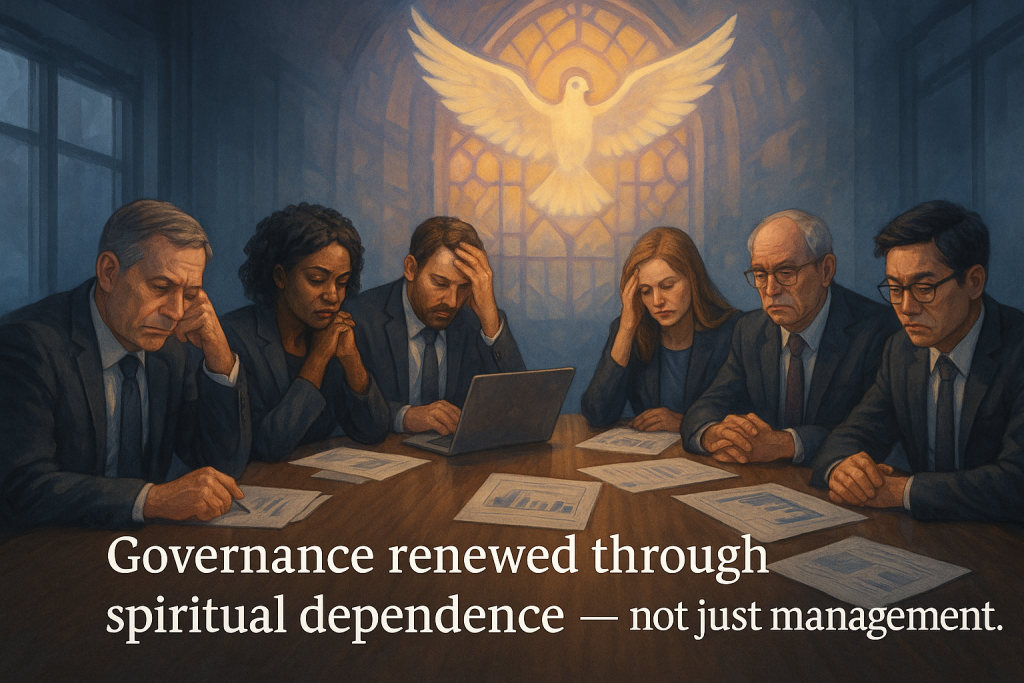
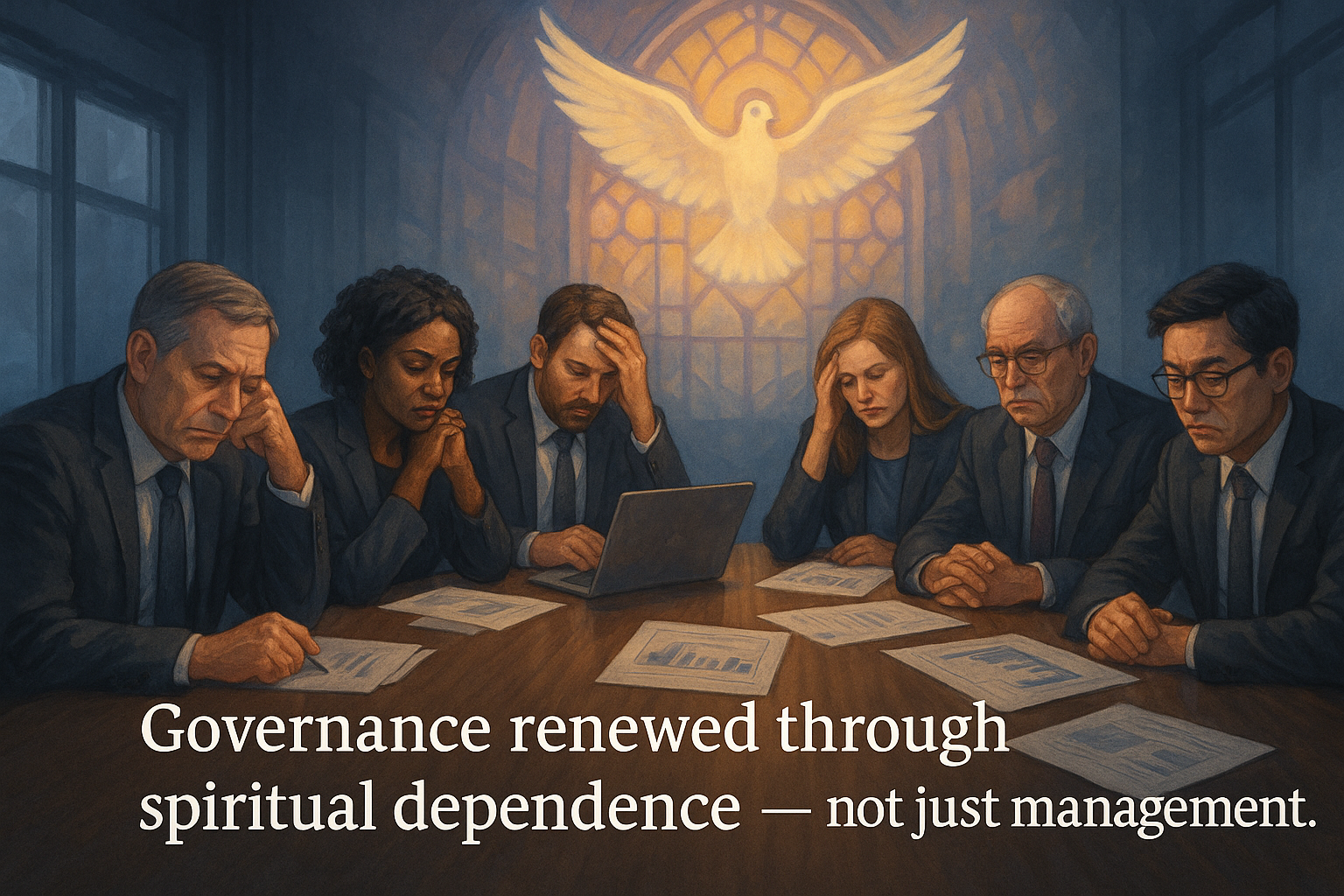
I’m sure most would agree that our dependence upon God should not only find expression in our respective ministry and operational contexts, but at a governance level as well. That is to say, our organizational spirituality cannot simply flow from the CEO down. It must also permeate the board. And from a renewal point of view, this means more than merely bookending our meetings with prayer.
Challenges Unique to Faith-Based Boards
Unfortunately, the very culture of nonprofit boards can often rally against this. Many board members are time-poor or may sit on multiple boards, often juggling other responsibilities. I clearly recall a meeting where I was pulled aside by a good friend and CEO of a mission during a break from our board meetings and rightly chastised for writing emails during a report that represented hours of someone’s ministry. The pull of conflicting responsibilities can so easily distract us from being fully engaged.
That same time pressure, along with funding constraints, can also result in less frequent in-person meetings and an over-reliance on digital means. This is especially true where board members self-fund their travel. And while we may applaud the availability of technology and the need for less travel, we must also ask if there are hidden costs to the proper functioning of the board and thus the organization.
With all of these pressures, how can we ensure the spiritual fervor of our boards reflects our “faith-based” status? And how can we bring about cultural change without simply adding to our already full agendas? I’ll be the first to admit that what follows is aspirational; however, if spiritual renewal is a timely subject for your board, here are three areas of conversation we need to have.
- Are we unified by a cause that transcends our core business?
While this may sound like business heresy, it is simply a matter of cause and effect. It is the acknowledgment that the primary cause behind all ministry productivity is God’s empowering presence. By core business, I am referring to the sum of our respective vision, mission, and strategy. While obviously it is good to be united on these matters, they are not enough in and of themselves to produce Kingdom impact. Our love for who God is—not what God does—must be our foundation for being.
“…we may find that we have less in common than we thought when lean times come our way.”
The church in Acts 2 was united in their deep sense of awe of God and by His Holy Spirit. The outcome was that “…the Lord added to their number daily those who were being saved.” [iii] Is the unity that flows from our relationship with Christ greater than that derived from what He may choose to do through us? If not, we may find that we have less in common than we thought when lean times come our way.
Some years ago, I was Vice-Chair of the board of an international mission. I noticed a pattern around day three of our meetings in which we seemed to come to an impasse on the most benign issues. As I discussed this with the Chair (a medical doctor), she had the wisdom to see that the combination of jetlag and long hours was causing a physical and then relational fatigue. From that day on, we renewed our commitment to one another’s spiritual and physical well-being. This gave us the space for deepening our relationships together, ministering to one another, and being human. I would now rate that board as one of the most united and productive boards I have ever had the privilege of serving on.
Our love for God is a powerful and deeply unifying force. Not only will it result in love for one another, but all of the fruit of the Spirit is promised to those who abide in Him. It can reduce interpersonal conflict, increase mutual understanding, and cement relationships. This is especially important for the board’s relationship with the CEO, who is their conduit to the ministry. It creates a safe environment for candid sharing, the surfacing of concerns, and for fostering creativity.
This will no doubt require the de-cluttering of meetings by means of pre-reading and effective delegation to subcommittees. Time for fellowship and the deepening of interpersonal relationships, for mutual caring and (on occasion) reconciliation, should be prioritized and unashamedly reflected in our agendas. It may be desirable to have less frequent but longer and more impactful meetings.
- Is spiritual development a board priority that is clearly stated and practiced?
While we often require a commitment to growth and transformation from our CEO, we don’t always articulate how we will hold ourselves to the same standard. This doesn’t mean it doesn’t happen, but if it isn’t clear to us, it certainly won’t be clear to others. I have heard some use the distinction between “elders” and “deacons” to appeal to the practical nature of board roles; however, Paul clearly expected the same quality of godly character from both. While spiritual vitality is usually expected, it should be a stated value that permeates both the formal and informal parts of our meetings. And it’s worth noting here that our corporate practices shouldn’t be relied upon to jump-start individual piety. Rather, personal devotion should flow into and fuel our board life. Our past agendas will tell us something about our priority for inner renewal, and our board skills matrix may indicate the extent to which this was expected.
Not long after starting a new pastorate, I was intrigued by the nomination of someone I deeply respected for our Church Council. While they were not known for their business acumen, they were well regarded for their prayerfulness and spiritual discernment. And while this raised more than a few eyebrows, the wisdom of their appointment was soon proven. It lifted the tenor of our meetings along with our unity and overall governance in tangible ways, leaving a lasting impact.
Overtly stating corporate renewal as a key priority for a board can help prevent a “spiritual” vs. “business” mindset from creeping in and better prepare us for the unique mix of faith and practice that our organizations need. It can also assist with the selection of new members whose alignment with the organization can be measured in part by their alignment with this value. Normalizing those practices into our meetings is an investment into board members and, for that reason alone, is a valid contribution. However, it is also likely to result in members demonstrating a non-anxious presence. After all, one of our greatest gifts to others is not our perfection but self-awareness. Additionally, our abiding relationship with Christ comes with unique assurances in matters of decision-making and petition. Practically, time spent in prayer and discernment can lessen our reliance upon data or interpretations of data that may clash, enable us to see a bigger picture, and prompt questions and ideas that we might otherwise have overlooked.
“There are few things that a board cannot outsource. Godly character is one of them.”
Capturing this commitment in our orientation materials is a good start, but we should also reflect it in our regular agendas. Gifts and experience in matters such as (but not limited to) prayer or spiritual direction might be included in our skills matrix. A common agreement to certain personal practices, or commitment to a local church or to being mentored, may also be useful. When succession planning, we should acknowledge the danger of a “skills first” mentality, which may inadvertently make concessions for known character flaws. There are few things that a board cannot outsource. Godly character is one of them.
- Do we recognize and embrace limitations as a good thing?
While a clear outline of limitations is basic to good governance, the faith-based nature of our organizations presents a layer of limitation that is hard to capture in a policy document. Faith, by its very nature, requires us to operate outside our comfort zone, where our vision for what could be constantly outstrips predictable resourcing. The push for certainty is, understandably, a constant temptation.
“…a lack of people or finances is not our greatest problem.”
However, a lack of people or finances is not our greatest problem. Our real struggle is against “…spiritual forces of evil in the heavenly realms.”[iv] There is no way to overstate this, against such opposition we are limited. This is not to deny that we are also uniquely equipped (which is, after all, what the Apostle Paul hopes to assure the church in Ephesus), but before we can suitably arm ourselves, we must first acknowledge the limitations of the weapons of this world. The dynamics of ministry that frequently baffled the disciples will need to become our constant study.
I’m currently being mentored by a retired pastor and counselor. Reflecting on the current state of the church and mission, he recently lamented the absence of what he refers to as a poverty of spirit. By this, he meant the humility and dependence upon God that undergird the very apostolic spirit so crucial to Kingdom work.
Identifying our limitations can help us to clarify our boundaries and hold us accountable to our governance structure where—regardless of the model—we all face restrictions. It not only builds trust and cohesion but actually shapes a culture that is equal parts expectant and patient—where response and pause rule over reaction and haste. Such a culture is more likely to foster the apostolic spirit that drives ministry momentum.
While the saying “stay in your lane” will be familiar to some, it is not always easy to do. It takes intentionality to ensure that governance theory actually converts into board practice. Clear term limits, office rotations, and succession planning are all necessary, and extensions of those limits should be avoided. All boards have “break glass in emergency” buttons available to them. These are levers or behaviors that are available in a crisis. What defines a crisis should be well understood. If we are not friends with constraint, those levers can easily be abused through; opaque meetings, selective reporting, ambiguous reviews and targeted consultations. We need to normalize pauses for prayer, embrace our limitations and resist reactionary leadership.
As mentioned earlier, much of this is aspirational. The point of these conversations is to seek to recapture (where needed) the faith-based element of our ministries by reinvigorating the spirit of the board. Further, the intent is not to diminish the importance or value of what we might commonly refer to as the corporate skill set, as if it were a choice of one or the other. Rather, as we seek to immerse ourselves afresh in God, we allow all of our talents, experiences, and attributes to be so saturated by His presence that the Spirit of God truly permeates all that we are and do.
[i] Asamoah, Kwabena. “God’s Mission Empowered by the Holy Spirit”. Plenary session, Fourth Lausanne Congress, Incheon Seoul, September 23, 2024.
[ii] Amalraj, John, Hahn, Geoffrey W, and Taylor, William D, eds. Spirituality in Mission: Embracing the Lifelong Journey, 200. William Carey Publishing, 2018
[iii] Acts 2:47 NIV.
[iv] Ephesians 6:12 NIV
This article was written by Stewart Hunt. Stewart Hunt has served as a pastor, missionary, CEO and board member for several faith based organizations.






Responses