

Natural Theology: Five Views
EMQ » Oct – Dec 2025 » Volume 61 Issue 4
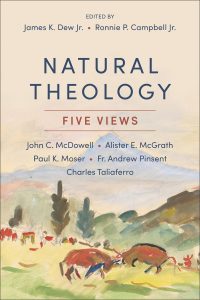
Natural Theology: Five Views
Edited by James K. Dew, Jr. and Ronnie P. Campbell, Jr.
Baker Academic, 2024
304 pages
US$17.37
*As an Amazon Associate Missio Nexus earns from qualifying purchases.
Reviewed by Mark A. Strand, PhD, professor, North Dakota State University, Fargo, ND.
When Psalm 19:1 says, “the heavens declare the glory of God,” what is it that the heavens are actually saying? Does the second of God’s books, the book of nature, say anything about God that is not known from the first of God’s books, the book of Scripture? This question is the subject of this fascinating, but challenging, book.
In Natural Theology: Five Views, the editors have compiled essays on natural theology by five leading theologians. The contributors include Charles Taliaferro, a contemporary view; Father Andrew Pinsent, a Catholic view; Alister McGrath, a classical view; Paul Moser, a deflationary view, and John McDowell, a Barthian view. Each author offers a 15–25-page essay explaining their view. Each of the four contributors then provides a response to the essay. Finally, the author gives a reply to their responses. This approach creates a very complete, and in-depth, study of the topic, but it makes for laborious reading. To their credit, the responses and replies were gracious and constructive.
Readers interested in the topic at a general level would benefit from just reading McGrath’s essay representing the standard evangelical perspective. McGrath sees value for believers in that natural theology allows them to make sense of the natural world from a Christian perspective, and value for unbelievers in that it affirms the rationality of the Christian faith. McGrath sees natural theology as not so much a proof of God’s existence but as an affirmation of human capacity to appreciate the creator God through experience. However, he is clear that natural theology does not provide information sufficient for salvation in the absence of special revelation.
For those interested at an intermediate level, just reading the five individual essays, without reading the replies, would provide a range of viewpoints from the Barthian view of McDowell, that rejects natural theology, to the contemporary view of Taliaferro, who is enthusiastic about natural theology’s ability to motivate individuals who experience god through nature to pursue god through Scripture. Although described as a deflationary view, and quite critical of the legitimacy of natural theology, Moser made the strongest argument for the need for humans to personally experience God in order to see God, even among people who have no conceptual understanding of God. None of the contributors spent much time wrestling with the effects of sin on humans’ ability to interpret nature.
Reading this book in its entirety is for those deeply interested in the topic. Cross-cultural missionaries teaching theology would find this book helpful. But few grassroots missionaries would find this book beneficial to their ministries, even though they may be ministering to people who are encountering the Bible for the first time, or for whom god in nature is part of their world view.
For Further Reading
With the Grain of the Universe: The Church’s Witness and Natural Theology by Stanley Hauerwas (Brazos Press, 2001)
No Other Gods Before Me? Evangelicals and the Challenge of World Religions edited by John G. Stackhouse, Jr. (Baker Academic, 2001)
Encountering Religious Pluralism: The Challenge to Christian Faith and Mission by Harold Netland (IVP, 2001)
God’s Rivals: Why Has God Allowed Different Religions? by Gerald R. McDermott (IVP, 2007)
EMQ, Volume 61, Issue 4. Copyright © 2025 by Missio Nexus. All rights reserved. Not to be reproduced or copied in any form without written permission from Missio Nexus. Email: [email protected].
Published by Missio Nexus, .