

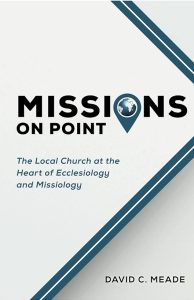
Missions on Point: The Local Church at the Heart of Ecclesiology and Missiology
EMQ » Oct – Dec 2025 » Volume 61 Issue 4
Missions on Point: The Local Church at the Heart of Ecclesiology and Missiology
By David C. Meade
Send Forward, 2024
336 pages
$9.99
*As an Amazon Associate Missio Nexus earns from qualifying purchases.
Reviewed by Brent H. Burdick, DMin, adjunct professor of missions, Gordon-Conwell Theological Seminary, Charlotte, North Carolina, and director of the Lausanne Movement’s Global Classroom.
There is a problem with missions in the local church. In fact, according to David C. Meade, the local church has abdicated its “biblical role and responsibility to mission agencies” (16). The role of the church is central to world missions, asserts Meade. It was never intended to be the sole responsibility of mission agencies. The church must understand and recover its mandate to be the primary sender of missionaries, and the partnerships between church and agencies must be refocused to where the church has priority and agencies support the church in global outreach.
Meade walks through the New Testament evidence for the local church having priority in global missions. He shows that Christ’s teachings focused on establishing and strengthening the local church for accomplishing his purposes in the world. He analyses the various “Great Commissions” in the Gospels and Acts and shows that each one ultimately points to the goal of missions being the establishment of local churches. Through the local church, evangelization, discipleship, administration of church ordinances, and teaching on the Word of God take place. Without the local church none of this would happen. So, missions is all about churches planting more churches, especially in areas where there are few or none.
Of course, very few churches have this level of commitment or engagement to global missions, and Meade has formed an organization (Propempo International) to help churches recover their biblical role and implement a plan. At the end of each chapter in the book, Meade tells a continuing story about a fictional church (compiled from the experiences of actual churches) discovering its role in global missions through a young couple who is called into missions. With Propempo’s training and assistance, the church discovers how to train and support the missionary couple, take the lead in partnering with an agency, ensure that new churches are being planted, and engage the whole church in the entire missions sending process. The result is growth in the local church, churches planted overseas, and more people sent out in missions.
The book is very positive in tone, easy to read, and engaging. Mission agency personnel may find it a bit disconcerting, however, as the role of the agency is subordinate to the church in every way in this paradigm. The vision and calling of the agency may come into conflict with the vision and calling of the local church and its control of the missionaries they send that is clearly advocated here. This presents a philosophical conundrum that is not fully explored in the book, though Meade asserts that the biblical perspective of the church having primacy in missions settles the debate.
The book has much to commend for missions endeavours in North America. It presents an inspiring vision and helpful strategies for greater participation by local churches in global missions.
For Further Reading
Loving the Church, Blessing the Nations: Pursuing the Role of Local Churches in Global Missions by George Miley (Authentic Media, 2003).
Mapping Church Missions: A Compass for Ministry Strategy by Sharon R. Hoover (IVP Books, 2018).
EMQ, Volume 61, Issue 4. Copyright © 2025 by Missio Nexus. All rights reserved. Not to be reproduced or copied in any form without written permission from Missio Nexus. Email: [email protected].
Published by Missio Nexus, .