

Evil: A North Korean Christian Refugee Perspective
EMQ » Oct – Dec 2025 » Volume 61 Issue 4
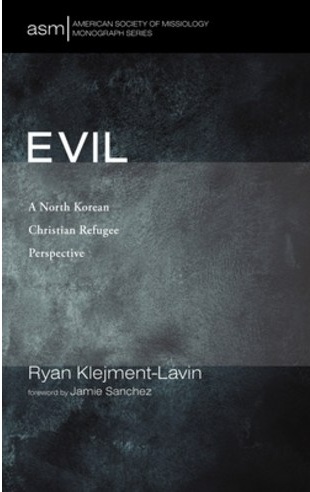
Evil: A North Korean Christian Refugee Perspective
By Ryan Klejment-Lavin
Pickwick Publications, 2024
182 pages
US$28.00
*As an Amazon Associate Missio Nexus earns from qualifying purchases.
Reviewed by David Cashin, professor of intercultural studies at Columbia International University, who served 9 years in Bangladesh and whose study area is Indology and the Sufi Muslim groups of Bangladesh.
Dr. Ryan Klejment-Lavin’s interview-based research on North Korean refugees in South Korea breaks some very interesting new ground in the study of theodicy and how humans react to evil and their own suffering. In this case North Koreans, who have made the perilous journey out of North Korea, reflect on their experiences both in North Korea and as refugees from perhaps the harshest regime on the planet. It is shocking that even as children many were forced to witness public executions. Their journeys to escape often involved being trafficked, sexual abuse, starvation, imprisonments, beatings and, in at least one case, being sent back to North Korea. The illumination of their experiences is ground-breaking in its own right. But Dr. Klejment-Lavin explores how these refugees deal with their traumas in the light of their present Christian faith.
Klejment-Lavin introduces his readers to the concept of “Juche” with its ten commandments of absolute obedience to the North Korean leader. He explains how amongst refugees this results in a kind of inverted juche where North Koreans are not masters of their fates, as Juche maintains, but are actually the ones oppressed by the Juche State. How is it that God would allow such an abominable system in a country whose capital used to be known as “the Jerusalem of the East”? Many South Korean pastors associate this with “God’s punishment for their sins.” Many of these refugees have also faced discrimination in South Korea. From their interviews, Klejment-Lavin weaves a fascinating self-portrait of people brought through great suffering with their insights and coping strategies. His conclusions I found quite encouraging. The North Korean Refugees rejected the concept that their people are being punished for their sins or that their circumstance is a fruit of their own actions. In fact, most seemed to have arrived at a nuanced view that still saw God as sovereign and the North Korean regime as responsible for the oppression of the vulnerable. Remarkably, after conversion, most came to a place of believing in a sovereign, loving God who would eventually establish justice and mercy.
In spite of the dark experiences covered, this is a very hopeful book. The North Korean refugees have found meaning in their circumstances. While their worldviews may not be internally consistent, they have found a way to believe in a God who is both sovereign and loving in spite of what they have personally experienced. Although academic, this is a good read.
For Further Reading
Hope for the Afflicted: A Framework for Sharing Good News with Asylum Seekers and Refugees by Jairo de Oliveira (Wipf & Stock, 2023).
Facing Fear: The Journey to Mature Courage in Risk and Persecution by Anna Hampton (William Carey Publishing, 2023).
The Insanity of God: A True Story of Faith Resurrected by Nik Ripken (B&H, 2026).
EMQ, Volume 61, Issue 4. Copyright © 2025 by Missio Nexus. All rights reserved. Not to be reproduced or copied in any form without written permission from Missio Nexus. Email: [email protected].
Published by Missio Nexus, .