

Community of Missionary Disciples: The Continuing Creation of the Church
EMQ » Oct – Dec 2025 » Volume 61 Issue 4
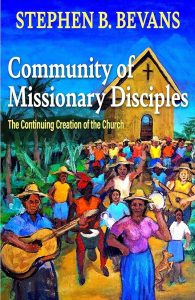
Community of Missionary Disciples: The Continuing Creation of the Church
By Stephen B. Bevans
Orbis Books, 2023
368 pages
US$55.00
*As an Amazon Associate Missio Nexus earns from qualifying purchases.
Reviewed by Martin Rodriguez, PhD, Associate Professor of Practical Theology and Missiology, Azusa Pacific University, and host of the Missiology Podcast.
“The point of the church is not the church” (86). Stephen Bevans – widely regarded as one of the leading missiologists of our day and professor emeritus of mission and culture at Catholic Theological Union – makes this central claim in various forms. Too often, ecclesiology has left mission on the sidelines, especially in his own Catholic tradition. Few phrases have reshaped Catholic mission theology more in the past decade than Pope Francis’s Evangelii Gaudium (2013) and its call for a “community of missionary disciples.” Bevans takes this as his starting point, arguing that the church is never an end in itself but exists to embody, proclaim, and demonstrate the reign of God. Its identity, leadership, and structures matter only insofar as they serve God’s mission in the world.
The book unfolds in three parts. Part one (chapters 1–5) grounds ecclesiology in biblical missiology, showing that mission is the source and shape of the church’s very identity – mission is “the mother of the church.” Acts, read as “the gospel of the Spirit” (Willie Jennings), portrays the Spirit as the restless character who drives the church beyond its own boundaries and comforts. For Bevans, this means the church is born in movement and grows only as it crosses frontiers. This section culminates with Bevans’s well-known theme of prophetic dialogue: mission practiced as respectful friendship and discerning solidarity.
Part two (chapters 6–10) turns to biblical images of the church – the people of God, the body of Christ, and the creation of the Spirit. Here Bevans insists that the church is fundamentally Spirit-made. His pneumatology is dynamic, disruptive, and missional: the Spirit as the restless, surprising power who continually recreates the church and pushes it beyond its comfort zones. Along the way he affirms Pentecostal vitality, critiques clericalism and exclusion, and presses for the full participation of women in the church’s mission. He closes the section by reframing the four classic marks of the church – one, holy, catholic, and apostolic – not as static adjectives but as verbs, dynamic missionary actions. The result is a missional ecclesiology defined less by boundary lines than by movement toward reconciliation, unity, and ecumenical openness.
Part three (chapters 11–15) addresses structure. In Bevans’s vision, baptism is “everything” – the sacrament that confers both equality and missionary discipleship. All Christians are missionary disciples by baptism, and all ministry flows from this identity. Leadership, Bevans argues, is not about control but about nurturing discipleship through vision, dialogue, and virtue, marked by qualities like humility, presence, and courage. Ordination – in its episcopal, presbyteral, and diaconal forms – is treated with both respect and candor: these roles carry real responsibility, but their only purpose is to serve the community’s missionary vocation. In Bevans’s telling, structures matter, but always as servants of God’s mission, never an end in themselves.
The book’s strength is Bevans’s remarkable breadth and ecumenical reach. His footnotes alone could launch a graduate seminar, weaving together Catholic, Protestant, Pentecostal, and liberationist voices. Evangelicals may find his Eucharistic emphases foreign, and his account of leadership could say more about how God’s agency interacts with human agency. Some readers may also wish for more practical guidance for local churches. Yet Bevans offers something evangelicals often need: a higher ecclesiology, one that honors the church’s role without turning it into an idol. In a culture where many “vote with their feet,” distrust tradition, and resist institutions, Bevans offers a rich, Spirit-shaped vision of church: not an end in itself but “the sacrament, the servant, and the herald of God’s dream for the world” (86).
This book will benefit seminary students, missionaries, and leaders across traditions who suspect that mission has too often been treated as an add-on rather than the heartbeat of the church’s life.
For Further Reading
The Church and Its Vocation: Lesslie Newbigin’s Missionary Ecclesiology by Michael W. Goheen (Baker Academic, 2018).
Prophetic Dialogue: Reflections on Christian Mission Today by Stephen B. Bevans and Roger Schroeder (Orbis Books, 2011).
Evangelii Gaudium: The Joy of the Gospel by Pope Francis (Libreria Editrice Vaticana, 2013).
The Go-Between God: The Holy Spirit and the Christian Mission by John V. Taylor (SCM Press, 1979).
EMQ, Volume 61, Issue 4. Copyright © 2025 by Missio Nexus. All rights reserved. Not to be reproduced or copied in any form without written permission from Missio Nexus. Email: [email protected].
Published by Missio Nexus, .