

Cabbages in the Desert: How God Transformed a Devout Muslim
EMQ » Oct – Dec 2025 » Volume 61 Issue 4
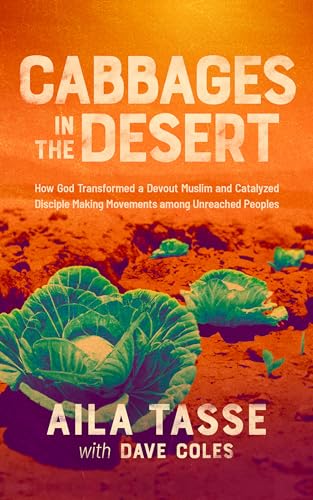
Cabbages in the Desert: How God Transformed a Devout Muslim and Catalyzed Disciple-Making Movements among Unreached Peoples
By Dave Coles and Aila Tasse
Beyond, 2024
322 pages
US$16.99
*As an Amazon Associate Missio Nexus earns from qualifying purchases.
Reviewed by Gene Wilson, church planting catalyst with ReachGlobal and co-author of Global Church Planting. Biblical Principles and Best Practices for Church Multiplication (Baker Academic, 2011).
It is no secret that the missionary effort is no longer exclusively from the West to the rest. Missiological practices, likewise, are increasingly traveling in multiple directions. We in the West have a lot to learn from the Global South, such as the ideas contained in this book. The story, set in the Horn of East Africa, offers valuable guidance about making disciples in spiritually arid places, as well as in Western post-Christian societies. It is full of lessons about courageously breaking with old paradigms and traditions that get in the way of contextual relevance and fruitfulness.
Tasse is no armchair theoretician. Growing up in a staunchly Muslim family, he came to Christ as a child through the patient witness of his missionary teacher. He tells the story of his ministry journey sharing Jesus in a spiritually resistant and sometimes hostile context. He compared it to growing cabbages in the desert – something only God can accomplish. He also enriches us with the observations and reflections of other colleagues working among diverse population segments.
The book is inspiring as well as instructive. It is a gripping account of a God-sized movement carried forward by the brave witness of non-professionals. Tasse gives us a behind-the-scenes look at the external and internal struggles he experienced on the journey from church to movement. There are numerous accounts of team members working with different people groups – Muslim and animistic, oral learners and literate, rural and urban. Those involved in cross-cultural mission will feast on the wealth of practical insights and strategic adaptations. Those in different fields of work will enjoy the stories of transformation.
Having read many books on Disciple-Making Movements, I appreciated that this account not only addresses starting movements but also reproducing and sustaining them. Tasse stresses the importance of establishing and developing Biblical elders as new churches are formed. Failure to do so has been the Achilles heel of many movements. The uninitiated in movement missiology will benefit from chapters 4 to 6 which constitute a good primer on Disciple-Making Movements. Those more experienced will discover a model of contextual adaptation and all will be inspired by what God is doing on the frontlines of kingdom advance in East Africa.
For Further Reading
Movement Catalysts: Profile of an Apostolic Leader by Emanuel Prinz (Self-Published, 2022).
Emerging Gospel Movements – The Role of Catalysts by Gene Wilson (Wipf and Stock, 2021).
EMQ, Volume 61, Issue 4. Copyright © 2025 by Missio Nexus. All rights reserved. Not to be reproduced or copied in any form without written permission from Missio Nexus. Email: [email protected].
Published by Missio Nexus, .