

A New and Ancient Evangelism: Rediscovering the Ways God Calls and Sends
EMQ » Oct – Dec 2025 » Volume 61 Issue 4
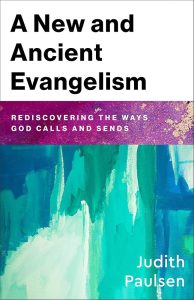
A New and Ancient Evangelism: Rediscovering the Ways God Calls and Sends
By Judith Paulsen
Baker Academic, 2024
224 pages
US$23.99
*As an Amazon Associate Missio Nexus earns from qualifying purchases.
Reviewed by A.G. Smith, PhD, a researcher and strategist with Pioneers, who served as a church planter and missionary trainer in the Middle East and Europe.
Evangelism in much of the Western church is often associated with intrusive strangers on airplanes, formulaic salvation sales pitches, or street preachers promising brimstone through bullhorns. While many Christians experience guilt over not sharing their faith more, few feel effectively equipped for speaking of Jesus in ways that seem authentic, respectful, and winsome to their hearers.
Judith Paulsen, professor of evangelism at Wycliffe College at the University of Toronto, has written an invaluable resource for churches and individuals desiring greater faithfulness in proclaiming the gospel. Each chapter of the book is organized around a conversion story from the New Testament, such as that of the Ethiopian eunuch, the disciple Nathaniel, and the Philippian prison warden. Paulsen navigates each story, drawing out biblical principles for evangelism that make sharing about Jesus accessible, intentional, and wholly dependent on God, the primary Evangelist (133). Underlying each story is the key theme of God’s work in evangelism of pouring out his Spirit, directing events and circumstances, and bringing spiritual fruit and growth in his time.
In chapter 12, Paulsen revisits the concept of the Great Commission as a duty or command to be obeyed. Rather than obligation, she argues that it is a promise of Christ’s presence and authority, as seen in Acts 1:8 (165). She writes, “A love for Christ, resulting from our encountering of him, must be our impetus for sharing the good news of Jesus” (171). It is this compelling vision of evangelism as participation in God’s redeeming and reconciling work which drives the entire book.
Paulsen’s approach is refreshingly relational and nonformulaic, as well as deeply rooted in Scripture. She includes missional practices such as hospitality, finding or building cultural bridges, prayer and listening for God’s direction, and attending to the ways God may have been working in that person’s life drawing them towards himself.
This book would appeal to church leaders who desire to equip their members for thoughtful and intentional evangelism in both word and deed. It provides compelling reasons for evangelism, as well as a plethora of practical ideas for both individuals and groups. Each chapter contains a helpful group discussion guide, encouraging Christians to examine their perceptions and practices of evangelism. In addition, the appendix includes “Experiments for Your Church to Try,” descriptions of tangible ways church communities can put the book into practice. A New and Ancient Evangelism would also be an ideal resource for anyone discipling new believers to appropriate the Christian story as their own and tell it to others.
For Further Reading
Sharing Faith: The Way of Shared Praxis by Thomas H. Groome (Harper Collins, 1991).
Questioning Evangelism: Engaging Peoples’ Hearts the Way Jesus Did, 3rd ed. (Kregel, 2023).
Breaking the Huddle: How Your Community Can Grow Its Witness by Don Everts, Doug Schaupp, and Val Gordon (InterVarsity, 2016)
EMQ, Volume 61, Issue 4. Copyright © 2025 by Missio Nexus. All rights reserved. Not to be reproduced or copied in any form without written permission from Missio Nexus. Email: [email protected].
Published by Missio Nexus, .