

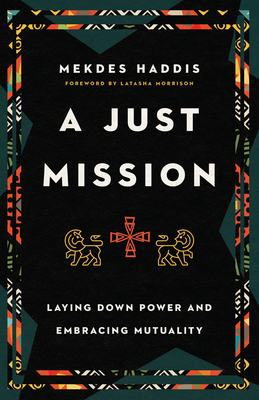
A Just Mission: Laying Down Power and Embracing Mutuality
EMQ » Oct – Dec 2025 » Volume 61 Issue 4
A Just Mission: Laying Down Power and Embracing Mutuality
By Mekdes Haddis
InterVarsity Press, 2022
227 pages
US$18.99
*As an Amazon Associate Missio Nexus earns from qualifying purchases.
Reviewed by Brittany N. Salmon, EdD, assistant professor, Liberty University, Lynchburg, VA, and author of It Takes More Than Love: A Christian Guide to Navigating the Complexities of Cross-Cultural Adoption published by Moody Publishers.
After immigrating from Ethiopia to the United States to attend university at a Christian college, Haddis shares her perspective on what it truly looks like to live out the Great Commission. As a self-proclaimed outsider who now has almost two decades of living in the United States, she shares a convicting assessment of the West’s approach to missions while also giving a few outlined solutions.
The book’s thesis is that the West must divest power over the narrative surrounding modern day missions, and the Global South should be given the opportunity to lead and tell their own story – without negative repercussions from the West.
This book is really two-fold. It’s the story of an immigrant’s journey to the United States and her awakening to the inconsistencies in the American church’s approach to missions. But it is also a overview of Haddis’s missiological perspective and her condemnation of the West’s approach to mission work in the Global South.
A few of Haddis’s strongest arguments are that missions should be relational, not transactional (100–101), short term mission trips must be completely reimagined (111–112), and the good news of Jesus needs to be strong enough to stand alone without strings of Western aid and/or cultural assimilation attached. She also argues that the power hierarchy that is typical within Western generosity needs to be dismantled, and she offers lessons from the Global South in how to have a more horizontal, or communal, way of giving (122-130).
One criticism of this book is that although some of Haddis’s observations are helpful, others are far-reaching. For example, in chapter seven she makes the assertation that many Western mission trips to war-torn countries lack the self-awareness to realize that their help is only needed because of the destruction by their own Western governments. In other words, these wars are the fault of colonization and Western aid alone (141). This might be true for some wars, but not all wars in Africa are the fault of the West. And although this reviewer agrees with the need for self-awareness and reform in Western aid policy, some of her commentary seems extreme and could distract from her main points of unity and reciprocity.
In the final chapters, Haddis leaves readers with a more hopeful perspective, “The new generation of missionaries is justice seeking and gospel believing. They are rising up to build a beautiful future for the global church. They understand that the church’s strength is in its people coming together to form a union that supports each other’s work but doesn’t conform to each other’s ways. They are a true picture of the body of Christ” (204). Her initial thesis of divesting the West of power and spreading it to the Global South to create reciprocity and mutuality is brought back to the forefront.
This book is a great resource for pastors and mission organization leaders who are wrestling with how to do short term mission trips well. It is also a good resource for anyone who is needing practical encouragement to partner with more local and indigenous ministries instead of ones directly connected to Western sending agencies. Haddis does not pull any punches, and this reviewer does not fully agree with each of her assessments and conclusions, but Haddis’s work is an important addition to the conversation surrounding what a healthy missions framework should look like.
For Further Reading
The Beautiful Community: Unity, Diversity, and the Church at Its Best by Irwyn Ince Jr. (InterVarsity Press, 2020).
The Gift of Disillusionment: Enduring Hope for Leaders After Idealism Fades by Peter Greer and Christ Horst (Bethany House Publishers, 2022).
When Helping Hurts: How to Alleviate Poverty Without Hurting the Poor by Brian Fikkert and Steve Corbett (Moody Publishers, 2009).
EMQ, Volume 61, Issue 4. Copyright © 2025 by Missio Nexus. All rights reserved. Not to be reproduced or copied in any form without written permission from Missio Nexus. Email: [email protected].
Published by Missio Nexus, .