




EMQ » Jan – April 2026 » Volume 62 Issue 1
Summary: The 10/40 Window highlights regions where people have least access to Christianity. It encourages Christians to focus missionary efforts on those areas. However, it has led to neglect of diaspora populations, such as Muslims living in the US, who also need outreach. Parada argues that mission should prioritize people over geography. He urges churches to balance global and local efforts and not to overlook unreached groups living nearby.
By José Cruz Parada
Introduction
Driving back from the city of Austin to our temporary home in rural Texas, my heart sank as I thought of our future. Only two months had passed after our return from 16 years of ministry in a Muslim country. Three of our largest supporting churches were dropping our financial support. The reason was our return to the US. The churches’ support policies stated that support was only for missionaries serving in unreached areas of the world, specifically the 10/40 Window.
Our plan was to serve among Muslims who resided in our city. The statistics showed that close to 45,000 Muslims, with 12 mosques, schools, cultural centers and businesses existed there. But few Christians were involved in taking the good news of the Gospel to them. These Muslims were coming from the very same nations of the 10/40 Window but were now here among us in the US! Just because they did not live in the 10/40 window, were they to be forsaken by the church?
The 10/40 Window Theory
Throughout church history, the Holy Spirit has raised leaders who have encouraged obedience to the Great Commission in Matthew 28:16–20. In recent decades, people like Ralph Winter, with the unreached people groups theory, Donald McGavran, with church growth theory, Peter Wagner, with spiritual warfare and geographical strongholds and Luis Bush, the 10/40 Window theory, have been key voices. Their influence has fanned the flame of world missions.
The 10/40 Window[i] was a term created by Christian missionary strategist and Partners International CEO Luis Bush in 1990. He used it to refer to those regions of the eastern hemisphere, plus the European and African part of the western hemisphere, located between 10 and 40 degrees north of the Equator. This general area was purported to have the highest level of socioeconomic challenges and least access to the Christian message and Christian resources on the planet.
| This Photo of the 10/40 Window by Unknown Author is licensed under CC BY-NC-ND |
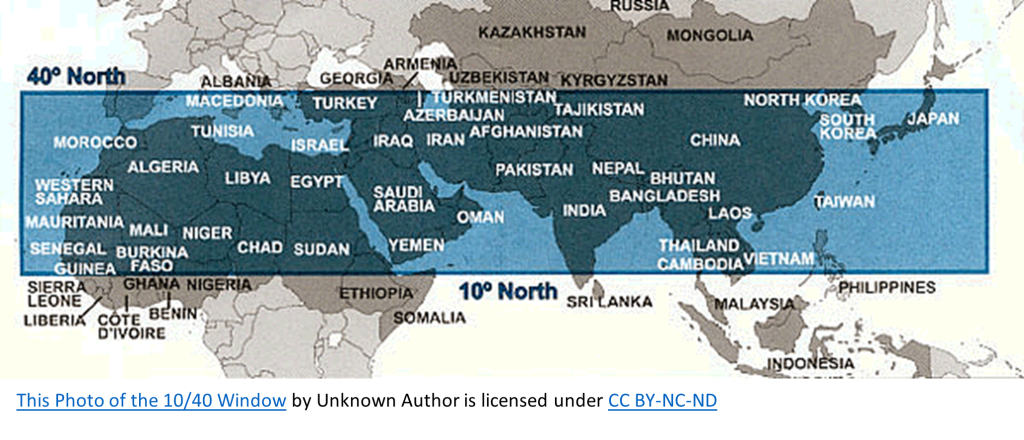
Figure 1 – 10/40 Window with countries
Soon after being launched, important voices in the missions movement adopted and promoted this theory. These included Ralph Winter’s US Center for World Missions, following up on his unreached people groups’ theory, Joshua Project, whose focus was researching unreached people groups, the Southern Baptist International Missionary Board and Bible translation ministries like ISL. It was a catchy and practical way of communicating about one of the neediest regions of the world.
The 10/40 Window was promoted by emphasizing these important considerations:
- Its historical and biblical significance — The Garden of Eden, Tower of Babel, and the places where Jesus and Paul ministered were all located in this region.
- The least evangelized countries of the world are found there. (These countries have less than 2% followers of Christ.)
- Most the world’s unreached people groups and their cities are located there.
- It is the area of the world where the three most prominent non-Christian religions have dominance: Islam, Hinduism and Buddhism.
- The 10/40 Window is home to the majority of the world’s poor. Of the poorest of the poor, more than eight out of ten live in the 10/40 Window.
- The billions of people who live in the 10/40 Window have suffered not only the ravages of poverty and disease, but they have also been kept from the transforming power of the gospel. The 10/40 Window was therefore proclaimed a stronghold of Satan.
Figure 2 – World non-Christian religious blocks
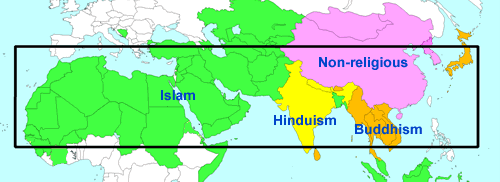
The three largest non-Christian religions are dominant in the 10/40 Window.
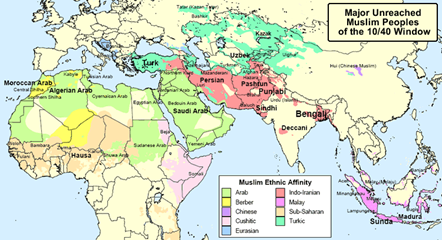
Figure 3 – Major unreached Muslim people groups
Source: Global Mapping International
My intention in this article is not to diminish the importance of missiological theories. They have informed and helped the church move forward in the missionary task. I am fully in agreement with what Joshua Project states: “There are approximately 16,800 unique people groups in the world with about 6,900 of them considered unreached. The vast majority (95%) of these least reached groups exist in the 10/40 window and less than 10% of missionary work is done among these people.”[ii] This paper is not an attack against Luis Bush, who was my pastor in El Salvador, my boss in Partners International, and who launched me into missions.
However, there are thousands of people from within those groups that have moved to the United States. As yet, there is no missiological theory that fully captures this situation and markets it well. The church remains indifferent. Thus, locally, we neglect to serve the very same peoples we send our missionary force overseas to reach.
The US Reality of the Muslim Presence and the Medina of America
John Wesley’s saying still holds true today: “The world is my parish.” In today’s global context, we must amend that and say, “The world is in my parish.”[iii]
The world’s population is about 24% Muslim. Islam is the world’s fastest growing religion, driven by the age and fertility rate of its adherents.[iv] This rate of growth is also true of the United States. Figure 4 shows the growth of Islam in the US up to 2017. The present Muslim population is about 4 million. African Americans are 20% of the total, or nearly 700,000.
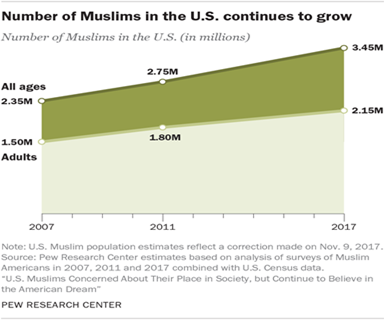
Figure 4 – Growth of Muslims in the US[v]
The Muslim presence is a reality in the US. Muslims are within reach in parks, schools, streets, theatres, sports events, post offices, gas stations, Targets, and Walmarts. We cannot hide our heads in the sand like ostriches and pretend not to see them. They are here, and they are included in the Great Commandment (Mark 12:30–31) and the Great Commission (Matthew 28:18–20).
In December 2019, my wife and I moved to the Dallas Forth Worth (DFW) area for family and ministry reasons. Here are the statistics for this area. The population of the DFW metroplex is 7.2 million people. Out of these, 2.5 million call themselves Christians. At the same time, there are over 300,000 Muslims (both Sunnis and Shiites). There are close to 80 mosques, Muslim cultural centers and schools that teach Islam.[vi]
Figure 5 shows the distribution of religions other than Christianity in the DFW area[vii]
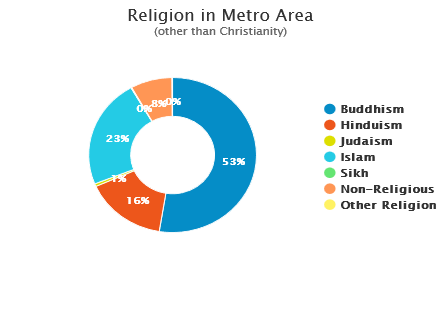
| Figure 5 – Religious affiliation in DFW |
Sometime back I received an email from a Christian working among Muslims in the DFW. The title was “Medina of America?”[viii] This was reported in the July 27, 2016, issue of Texas Monthly. DFW has a strong economy, many job opportunities, and similar weather to many parts of the Middle East. This has made it one of the fastest growing regions in terms of Muslim presence. According to the latest statistics, DFW has the fourth largest Muslim community and the second fastest growing Muslim community in America. With its growth in Muslim population, DFW has also become a magnet for Islamic scholars, apologists, and trainers in Muslim outreach. The email concluded stating “It is easy to see the DFW becoming the base of operations for the spread of Islam in America. The best way to address the issue: Love, prayer, and the gospel.”
The Effects of the 10/40 Window Theory
The 10/40 Window theory has had a major effect on mission to the Muslim diaspora in the US and other similar countries. It has resulted in their not being seen in the countries they have migrated to. There are few workers among them and minimal funding for this work. Christians are misunderstanding their responsibility for mission and are apathetic about reaching the Muslims in their communities.
The Lack of Focus on the Muslim Diaspora in the USA and Other Parts of the World
The promotion of the 10/40 Window showed the need of those in that region but ignored the need in other latitudes. This encouraged the neglect of diaspora peoples that are among us. It motivated churches to send missionaries to that region of the world but forgot the sending of missionaries to Muslims in the US and other diaspora communities.
The 10/40 Window theory, which started over 30 years ago, did not foresee the growing instability in socio-politics that produced groups like the Arab Spring, and the emergence of radical Islam. Groups such as Al Qaeda, Al Sharia and Isis accelerated the displacement of millions of people within and outside of the 10/40 Window. Most tried to get to Europe and Western nations. According to the United Nations UNCHR, the number of forcibly displaced people is 71 million. There are 25.9 million refugees worldwide and 3.5 million asylum seekers. The countries which have contributed the most displaced people in recent times are Syria (6.7 million), Afghanistan (2.7 million) and Sudan (2.3 million).[ix] Often, books and articles on reaching out to diaspora peoples seem to focus more on those living outside the US than those living inside it. As Mike Pocock states: “individual missionaries working among diaspora people I’d say they are having wonderful success, a receptivity in Greece, Turkey, UK, and Spain. Even when local existing churches may be sitting on the sidelines about ministry to refugees and immigrants.”[x] My personal experience is that most of the ministry among Muslims in Texas is in the hands of parachurch organizations. Are local churches in the US “sitting on the sidelines” as well?
A Tiny Missionary Force Among the Muslim Diaspora
The number of full-time missionaries working with the Muslim diaspora in the US is unknown. I have tried different credible sources, yet a clearing house for such numbers does not appear to exist. According to my short personal experience in two major cities — Austin and Dallas-Fort Worth, Texas, the ratios of missionaries to the number of Muslims is tiny. In Austin, there is an average of 18 full time workers for 45,000 Muslims. In the DFW area, the proportion for the 300,000 Muslims is probably similar. John Bitar, the director of Good News for the Crescent Road, said the following: “Only between 2–8% of our evangelistic effort in the US is directed to Muslims living in the West. There are more American missionaries or evangelists reaching out to the 740,133 people of Alaska than to Muslims in the entire world.”[xi]
Most of those I have met in Austin and DFW area who work among Muslims full time, are people who have not previously served in Muslim countries. This is wonderful! But what happened to all those who have returned after serving as missionaries among Muslims outside the US? What do they end up doing upon their return to the US? Those that I know and have heard of are working in churches as pastors. Some are Uber drivers. Others have started businesses. Some work in NGOs or are executives in missionary agencies. Why are they not still involved in working with Muslims?
Lack of funding may be a major reason.
A Lebanese Christian leading a ministry among Arabs in North Dallas expressed that the hardest thing is the lack of support from the churches at every level, including financial support. He observed, “There seems to be a lack of interest in the Muslim population.” Another leader who works among Muslims, commented that when the Syrian crisis started, they had so many people trying to volunteer and help financially, but now things are different.
Maybe the church is not funding the work with Muslims in the US because the church has lost its passion for the lost. Perhaps it has become more concerned with other issues.
Figure 6 shows how the White evangelical church in the US sees Muslims, according to Pew Research Centre data from 2017.[xii] This chart shows a clear bias against Muslims in general. Is the church not reaching out to their Muslim neighbors due to this bias? Let’s remember that the church that has been the major mission force worldwide in the last two centuries is the White evangelical church.
At the same time, other questions arise regarding the Latino, African American, and Asian churches? Why are they not doing the work of reaching out to their Muslim neighbors?
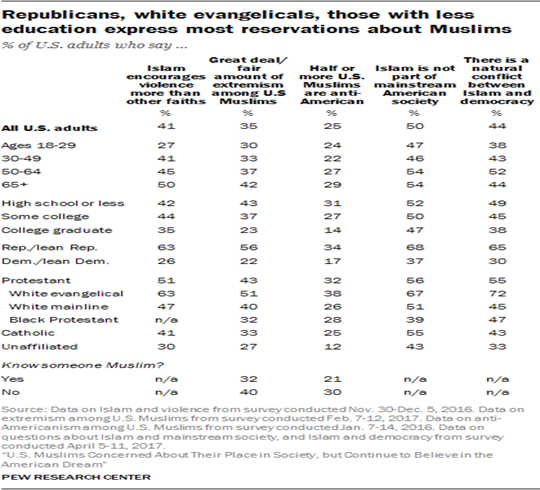
Figure 6 – US views on Muslims [xii]
A Distorted Effect on the Understanding of the Mission of the Church
The 10/40 Window, which revealed the millions of peoples that are in darkness in that region of the world, was never meant to cause the church to ignore those from that same Window, who live among us and are our neighbors.
The weakness of the 10/40 Window theory is that it focuses on the peoples of one geographical area of the world. Surely it is the people who are important, not their geographical location. The Scriptures teach that God seeks out each person wherever that individual is geographically (Luke 15:3–7). Yes, they could be in the uttermost parts of the world, but they could also be in Samaria, Judea, or even in our own Jerusalem (Acts 1:8).
The world is changing. Regions of the world are made closer by technology. But there is no substitute for the real-life missionary serving real people. Today, the mission field is everywhere. Mission is from everywhere to everywhere. I visited Argentina last November 2019. It surprised me to see the large Chinese population that has moved to Buenos Aires. The good news is that the church is waking up to the idea that they need to reach out to them. Tennent speaks to this issue: “the mission field is now everywhere, the classic (and important) distinction between monocultural evangelism and cross-cultural missions has become more nuanced. As we shall see, the distinction must be retained, but we must separate it from its long association with geography. Indeed, even after Ralph Winter dropped ‘the bombshell on the playground’ of the missionaries of Lausanne I in 1974 when he declared, that missions is about peoples, not places, we still labor quite heavily under geographic paradigms and assumptions regarding the world, the church and the mission field.”[xiii] In other words, the mission of God needs to happen where the people are. Those unreached people groups among us in the US are as important as those in the 10/40 Window.
Conclusions
The 10/40 Window has many positive aspects. It identifies the least reached peoples of the world and their specific locations. It raises a sense of urgency to reach these peoples, resulting in much focused prayer and Bible translation. It has also resulted in the sending of thousands of missionaries to some of the neediest regions of the world.
However, the 10/40 Window theory has oversimplified the biblical perspective of God’s mission through the church. It seems to have fostered a lack of interest for people that are not physically in the Window, including diaspora movements across the world. It has also caused the neglect of missionaries who serve outside the Window.
Strategies might vary but biblical principles do not change. The church should not place missiological theories ahead of biblical imperatives for mission. The Great Commission of Matthew 28:18–20 and Acts 1:8 must be in balance with the Great Commandment of Mark 12:30–31. Our neighbors are no less important than those who are far away.
[i] Luis Bush, https://luisbushpapers.com/1040window/
[ii] https://www.globalfrontiermissions.org/missions-101/the-unreached-peoples-and-their-role-in-the-great-commission
[iii] Tennent, Invitation to World Missions: A Trinitarian Missiology for the Twenty-First Century (Kregel Academic, 2010) 45.
[iv] Michael Lipka, “Muslims and Islam: Key Findings in the US and around the World,” Fact Tank News in the Numbers, August 9, 2017, Pew Research Center www.pewresearch.org/fact-tank/2017/08/09/muslims-and-islam-key-findings-in-the-u-s-and-around-the-world.
[v] Lipka, “Muslims and Islam.”
[vi] Southern Texas Baptist Convention, “Facts about the Religious Make up of the DFW Area.” Peoplesgroup.info. Religious Make up of the DFW Area (blog), n.d. https://www.peoplegroups.info/site/MetroHighlight/id/19100/name/Dallas-Fort+Worth-Arlington
[vii] Southern Texas Baptist Convention, Facts about the Religious Make up of the DFW Area.
[viii] E3 Leader, email to author, January 15, 2020.
[ix] UNHCR, “Figures at a Glance,” November 4, 2025, https://www.unhcr.org/about-unhcr/overview/figures-glance
[x] Michael Pocock, email to author, February 28, 2020.
[xi] John Bitar, email to author, February 27, 2020.
[xii] Lipka, “Muslims and Islam: Key Findings in the US and around the World.”
[xiii] Tennent, Invitation to World Missions, 24.
José Cruz Parada has served as a lead pastor in Central America, Latin America coordinator for a non-profit organization, and a cross-cultural church planter (Middle East, El Salvador, US). He is presently a higher education administrator and teacher at Dallas Theological Seminary.
He is married to Betsy, the women’s minister at Northwest Bible Church in Dallas, Texas. They are the parents of Andrés and Camilla, married to Elijah Kost, and the proud grandpa of Leon.
EMQ, Volume 62, Issue 1. Copyright © 2026 by Missio Nexus. All rights reserved. Not to be reproduced or copied in any form without written permission from Missio Nexus. Email: EMQ@MissioNexus.org.



Responses