EMQ (Evangelical Missions Quarterly)
July–September 2026 | Volume 62 Issue 3
(If you encounter difficulty, contact [email protected])
Editorial
Editorial – Discipling
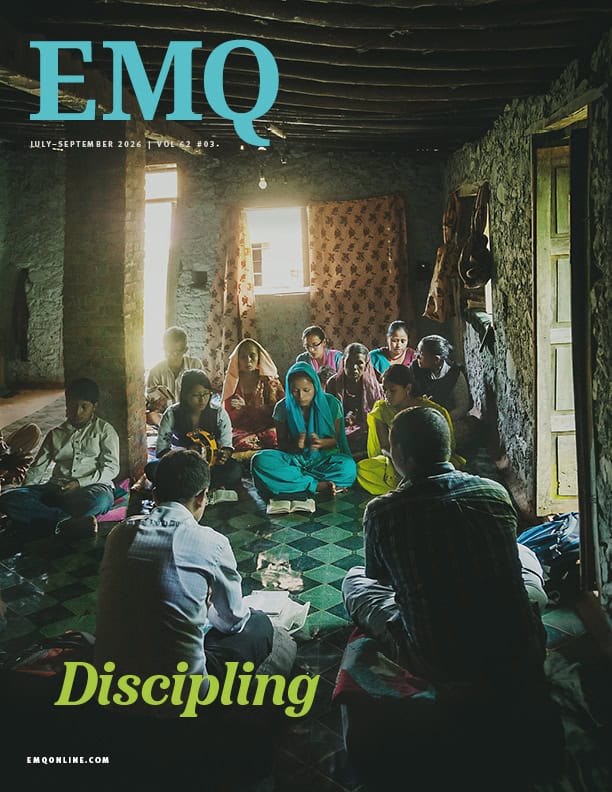
By Evelyn Hibbert | Jesus’ disciples walked with him, ate with him, lived with him, hurt with him, and later reproduced what they experienced. The most effective discipling occurs in multigenerational community. It is active and flexible to changing circumstances. The best disciplers come alongside disciples, teaching them to apply the Bible amid the challenges of everyday life.
Discipling
Five Questions about Disciples and Disciple Making
By Andy Smith | As a missionary trainer, Andy Smith has encountered five questions about discipling repeatedly. These questions explore whether discipleship relates only to spiritual life, whether or not to use qualifying adjectives with “disciple,” who should make disciples, what the discipling relationship looks like, and whether only new believers need to be discipled. This article presents the answers that Andy and his OMF colleagues have developed in response to these questions.

Reframing Cross-Cultural Discipleship around Allegiance: Promoting Peace, Reconciliation, and Freedom from Fear
By Bryan Carey | Byran Carey argues for a deeper, more lasting approach to cross-cultural discipleship centered on allegiance to Jesus and participation in God’s work of peace and reconciliation. He contrasts the effect of focusing on doctrinal boundaries versus reordering loyalties. This kind of discipleship is slower, but it forms communities characterized by humility, restored relationships, and lasting faith.
Being Among the Lost: Discipleship Must Move Back into the World of the Unreached
By Manuel Becker | What if the church’s greatest obstacle to mission is church life itself? This article introduces “Church-Gravity Syndrome,” the tendency of Christian communities to pull believers away from the very people they hope to reach. Drawing on Jesus’ ministry and movements in Thailand, it shows how discipleship flourishes when believers minister among the lost. Practical steps for cultivating an incarnational presence among the lost are discussed.
Discipling Leaders Across Cultures: A Four-Dimension Framework and How to Apply It
By Joseph W. Handley Jr. and Mary Jo Wilson | Handley and Wilson present a framework of four overlapping dimensions for effective cross-cultural discipleship based on their decades-long experience of developing leaders. These four dimensions are abiding deeply in God, forming Christlike character, using simple reproducible disciple-making practices, and catalyzing movements.

Obstacles to Forgiveness Among Turks
By José L. Cruz Parada | Forgiveness is a major topic in Christianity yet largely ignored in Turkish culture. This article presents the reasons why that is and gives practical suggestions on how to teach it to others especially for those serving among Turks.

Curses Can’t Harm Me, Right?
By Neil Miller | This article explores the often-overlooked biblical topic of curses and asks an important question, “Can they really affect people today?” Drawing from real-life stories and Scripture, the author examines what the Bible teaches about curses, how they operate, and why believers should take them seriously. It also offers practical guidance on how to respond when someone believes they are cursed. Readers will gain a clearer biblical perspective and practical steps for addressing this challenging spiritual issue.
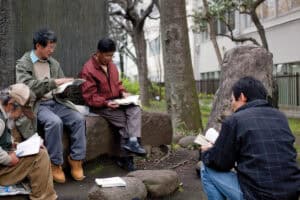
Ending Bible Poverty: A Research-Driven Approach
By Matthew Elliott | Matthew Elliott discusses how ending Bible poverty requires more than translating Scripture into every local language. Drawing on research from Africa, he argues that most people read in national or educational languages and lack access to the Bible due to cost and distribution issues. Elliott calls for a research‑driven, transparent, sustainable approach that prioritizes Bible engagement, local publishing, effective distribution, and contextual discipleship.
Evangelism
Introducing God’s Word into Spaces Where People are Looking
By Matthew Summers | As billions live inside the mobile scroll, the challenge for evangelism is no longer over ideas but over attention. Matthew Summers explains how placing God’s Word where people actually look is an effective first step in evangelism. He shows how short form video can create first contact with biblically disengaged audiences. He also provides some insights into how to effectively engage in digital ministry.

What’s in a Name?: Using Different Languages’ Names for God
By Mark Durie | Many Christians are unsure whether it is okay to use Allah and Isa for God and Jesus. In many Muslim-majority contexts, believers do use these names. However, patterns vary in the use or avoidance of these names. Iranian believers use Isa but not Allah. Malay believers use Allah but not Isa. Recent research into pre-Islamic Arabic has thrown new light on the origins and early use of these terms among Christian Arabs. It is important to realize that the authority found in the name of Jesus is not dependent on the precise phonetic form used to name him.
Church Planting
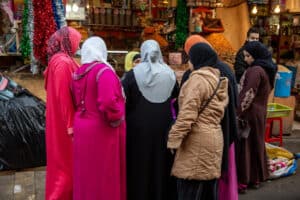
Remember the Women: The Need to Recognize Gender Dynamics in Church Planting Movement Strategies
By Eliza Kettering | Many church planting strategies suggest the importance of the familial web of relationships for the spread of the gospel. These strategies emphasize the speed in evangelizing within a family after coming to faith.
Partnering

Reframing Mission Support for the Majority World
By Gillian Mwaura (Edube) | African participation in global mission is expanding, yet this movement will not be sustained by replicating imported funding systems. Many prevailing models, shaped in Minority World contexts, fail to reflect African economic patterns, communal values, and cultural realities. Majority World mission systems must be rooted in local contexts while remaining globally connected. The article outlines the challenges associated with applying non-contextual funding models and suggests possibilities for collaboration and partnerships in God's global mission.
Principles for Practice

Broken Crayons: Learning to Allow People to Discover Meaning in Ways that Make Sense in Their Culture
By Jennifer W. Belcher | Using the Story-Based Trauma Healing course as an exemplar, Jennifer Belcher discusses how a learner-centered, resource light, and localized approach could make biblical transformation easier for the Papua New Guinean learner and other learners around the world.